
Thinking Through Quilts
Tending the threads that pull me forward

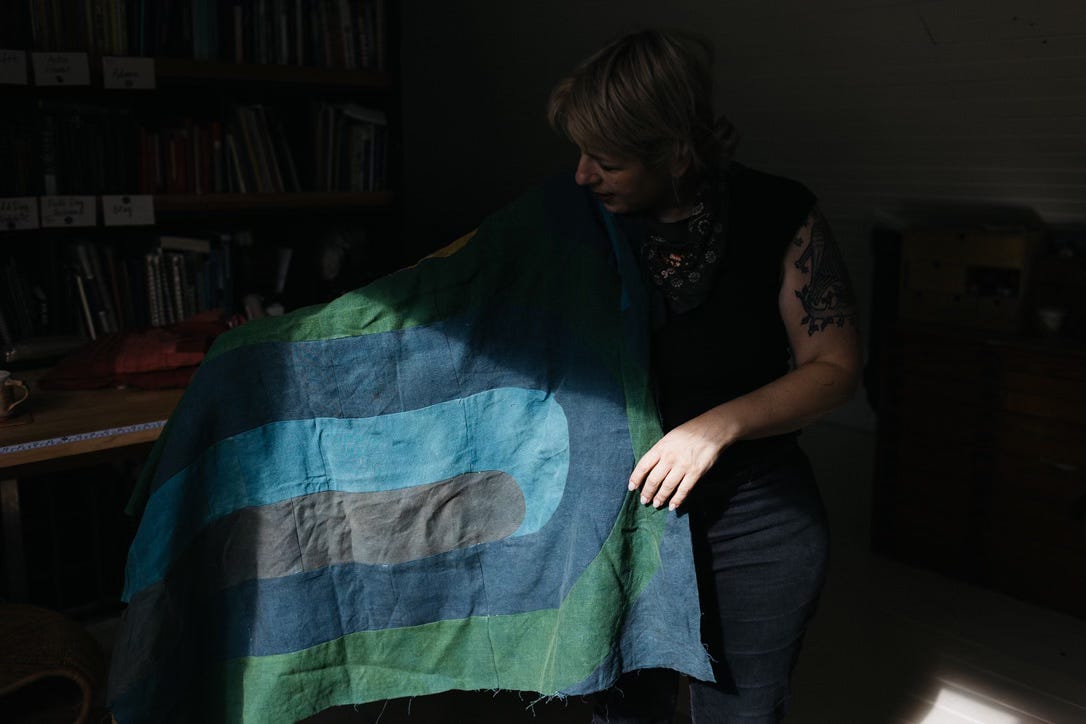
I’ve accomplished more than I set out to do as a quilter when I started in early 2021. I made quilts for every room in my home. I wrote over 100 blog posts here on Substack, I have kept a few years of daily studio journal with social media. I have met and connected with other quilters and I have dyed all my own fabric along the way. Now I can feel something new beginning in my quilting practice, but I can’t yet see its shape.
In this essay I will show how I am tending to this feeling and how the practice of thinking with quilts supports change and movement in our work. I am drawn to the grounding work of naming what matters to me as an artist and a quilter, to a few formative moments that clarified those commitments, and finally back to the daily rhythm of making: stitch after stitch.
Thinking about the Invisible
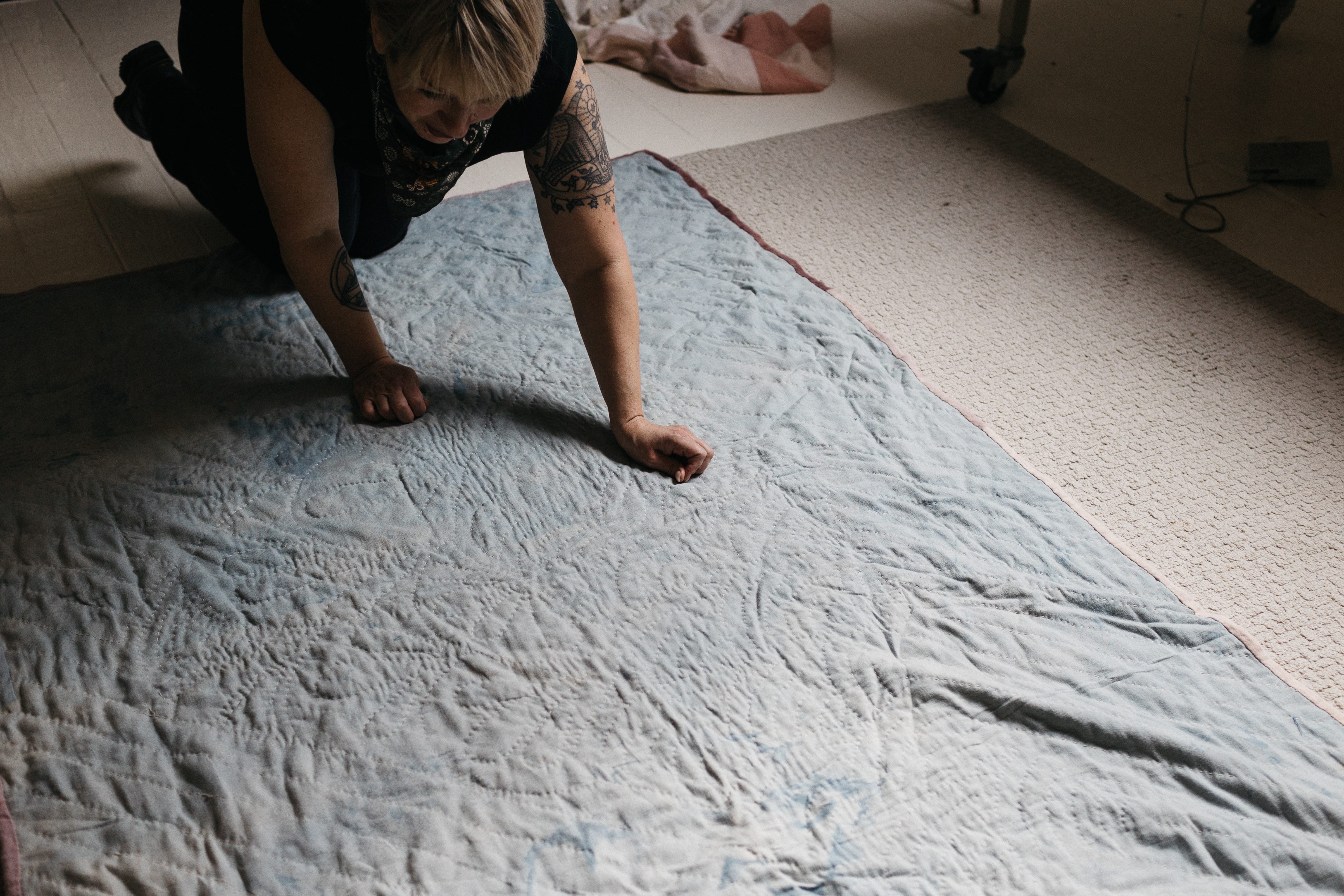
Do you ever find yourself thinking about something that you can’t directly think about? I have been having dreams lately that I can’t quite remember, but I catch flashes of them that feel like déjà vu. What I am not quite thinking about is my quilting practice. It feels like something stirring inside of me, around me. A storm rolling in, or a baby waiting to be born.
When my first child was inside me, I thought about her all the time, but I had no reference point. I had no sense of what she was. She didn’t even have a face, that most basic characteristic that grounds our connection to another person. She was invisible yet absolutely real. That’s a little how I feel now.
I’m not telling you this to say that I have been brewing up something behind the scenes that I am keeping secret from you, ready to reveal. I am brewing up something behind the scenes that I am keeping secret from myself. Oh, the anticipation. Sometimes thinking through quilting means sewing in the dark.
During phases like this, what do you do? When I was pregnant, I was horrible at nesting. When we had our child we never made a nursery. I was so attached to my single life and so excited for parenting that I reacted with a mix of denial and commitment. My mom gave me a changing table and I said, why would we need this? Can’t we just change her on the bed? My spouse said, Sarah, this will be useful. Babies need a lot of stuff, and we can put it all here. Good point.
Naming My Taste that Guides my Choices
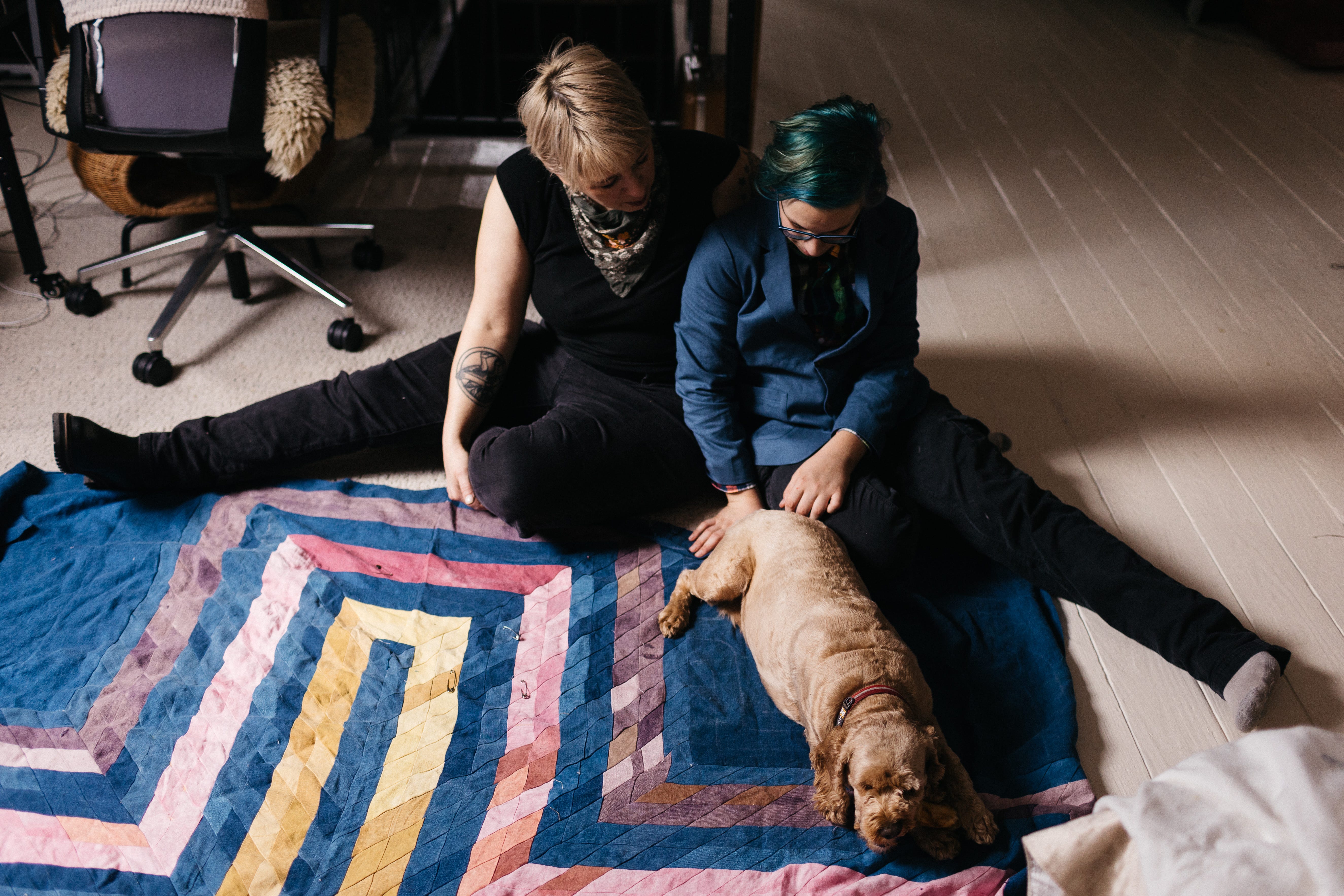
During that time I did have one kind of nesting, though it didn’t look like a nursery. This was the grounding work of naming what matters to me. I spent hours on Pinterest, making collections of things I liked. Rooms, clothes, paintings, colors, textures, objects. It wasn’t pre-verbal or vague. It was an act of articulation. By choosing, grouping, and returning to certain images, I was making clear statements about myself. I could see the shape of my attention, written back to me. And in retrospect, that mattered more than any preparation I refused, because it gave me a way to keep myself in the room while my life was being rearranged. That’s the kind of preparation I’m capable of now too: not trying to know the future, but tending the thread of my own taste until it can pull me forward.
When I was pregnant, we talked about what it would be like to parent. Naming what mattered to us. We talked about who we were and who we wanted to be. I remember saying together that our parenting philosophy would be that each day this child would move a little more toward her own independence. It would be our challenge to give her the support she needed while not holding on too tight. The first and most visceral expression of this was to be her moving from my body.
There is something comforting about an idea or a new movement in your work when it is still just an idea. It could be anything. It doesn’t have a face. It is unnamed. It is inside you and you own every part of it. The moment a thing comes into the world, you lose that control. It takes on a little independence. It starts doing its own thing.
Naming the Principles that Guide my Practice
So during this phase right now, I react the same thing I did when I was about to give birth to my actual child. I resist nesting, but I do little things to prepare that I can bring myself to. I think about my philosophy as an artist, a quilter. I try to capture glimpses that pass through the corner of my eye. The déjà vu moments from my dreams provide the smallest hints, but none of them make any sense. Even so, I am thinking through quilting.
What I am circling toward is not just a feeling, but a set of principles that have quietly guided my work for years. Here are some of the ways I have thought through quilting in my life. The grounding principles of my practice, like that slow dance between dependence and independence, are the same ones that have guided my parenting all these years, and they guide me here too.
My work as a quilter is made within a lived, domestic, and material practice. It is one that ends in the home, on a bed, covering a body. At the same time it draws on the reflective, self-aware modes of artist writing more commonly associated with fine art. I call myself an artist and I call myself a quilter. I am not attempting to reconcile or elevate quilting within the art world. That hierarchy isn’t interesting to me and that split isn’t useful for me. I am not trying to get galleries to take me seriously, because I want my work to live in a home. On a body, not on a wall. To me, a quilt is fully sufficient.
I find it useful to take on some of the modes of the fine artists. I constantly borrow the reflective vocabulary artists use to think publicly about their work. This is meaningful to me because it offers me, and possibly other quilters too, a way of engaging our work with depth, intention, and cultural awareness without abandoning the intimacy, tradition, and use of the quilt. I have found it so useful to use my quilts as a place to reflect just as you would with a painting or sculpture.
Naming our Era
There are material realities for us not just questions of our own identity that we have to think through. For many, it is about how we make our living. As artists, we make things out of the ingredients of our souls that can be placed in a store and sold for money. This is odd. It creates deeply conflicted feelings and, of course, all kinds of insider and outsider groups. It separates those who can sell their work for large sums and those who have exquisite craftsmanship yet cannot sell their work for anything near a living wage.
This is further exacerbated in an era where artists see their ideas stolen and then made for pennies. I won’t pretend that I understand what is happening with all of this on a larger cultural and global scale. What I do know is that despite all this, I want to make art in a deeply specific, traditioned, and well-crafted manner.
Naming the Past
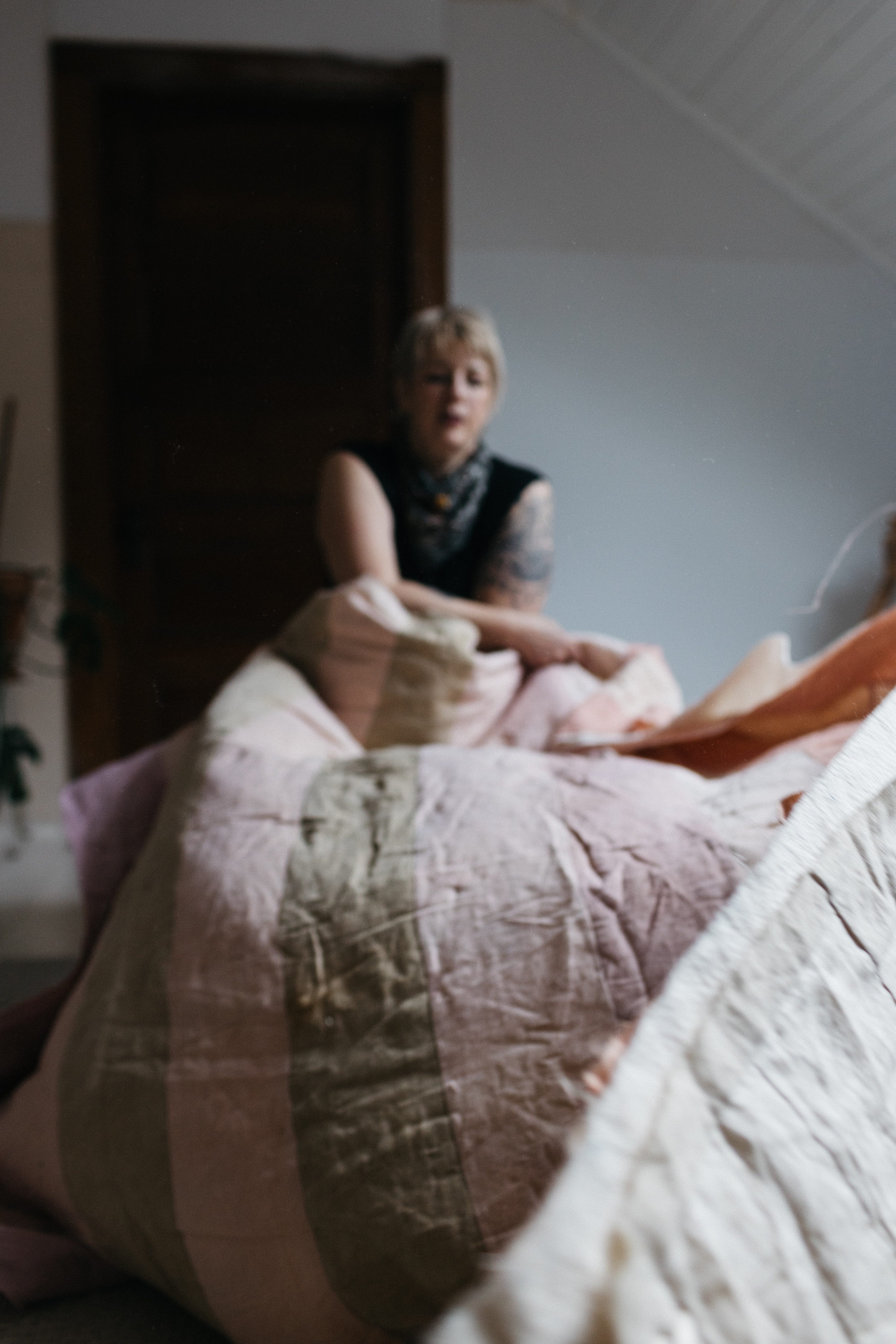
I also use this time of waiting to reflect on the changes I have gone through in my work. These are the moments of remember an initial spark, a breakthrough, a rupture or meeting a goal. One big goal for me was to become a writer, using quilts as a medium for these essays. I had a significant roadblock to this goal.
I spent most of my twenties and thirties being deeply uncomfortable with any thought of my anonymity being broken. My thoughts were my own. I didn’t want to share them to be examined or judged. That’s a big problem is you want to be a writer. What is a writer without a reader?
In my forties something shifted and I felt exactly the opposite. I wanted to write and share my work for the first time ever. It was an epoch shift for me. It was something I didn’t see coming and something that shocked me. I have been weird about it just like I was weird about welcoming my first child: unwilling to nest, barely willing to prepare, yet fully excited about the ride.
The regular practice now of making work and writing about it has become so integral to my life. Its so part of my regular rhythm now that it seems shocking that there was a time I could not imagine doing this. Writing became another way of stitching. It is slow, though more exposed.
This dream to be a writer was tested soon after I began to write publicly. A year or so into sharing my interest in quilts online I had an internet thing happen. Someone who didn’t like my approach began calling me out and contacting professional colleagues to besmirch my name. This was painful because it damaged some very exciting opportunities and I was treated so aggressively and impersonally. They didn’t call me or try to get to know me. They spoke against me online and then blocked me. This was someone I had been inspired by and respected.
I have come to see this as an internet thing because it is indeed a type of thing that happens commonly online. The reality is that while I love this person’s work and ideas, I also don’t agree with them about many things. They are subtle differences, but they are differences. In an ideal world, these things could be talked about with nuance and in a manner that respects the complexity of the world and traditions of textiles and quilts. Instead, the internet, with its short statements, gates, and walled gardens, can become a shockingly violent space.
I was invited by a publication to do a public debate, and I found this too confusing. I was hurt and had never even had a conversation with this person, nor had I heard their argument against me in a coherent way. I didn’t have my footing for a public debate.
Instead, I decided for the first time to write my own ideas long form. That rupture did not end my work; it clarified why I needed a longer form to hold it. That conflict was really the beginning of these essays. It brought up a real desire to create more nuance and more complexity within myself. I am not here to change one person’s mind on the internet. Yes, it hurt, and it sucked to lose out on things I was excited about. But I also saw a real opportunity to move from writing my ideas in one-liners or short paragraphs to really working them out in a nuanced and complex way.
That is what the last few years of quilting and writing have been for me. That is the matrix of the creative space that opened up in my life. It turned out all my fears of losing my anonymity were correct, and yet I wouldn’t trade it for the ability to write.
Enough Names. Just Make Something Already
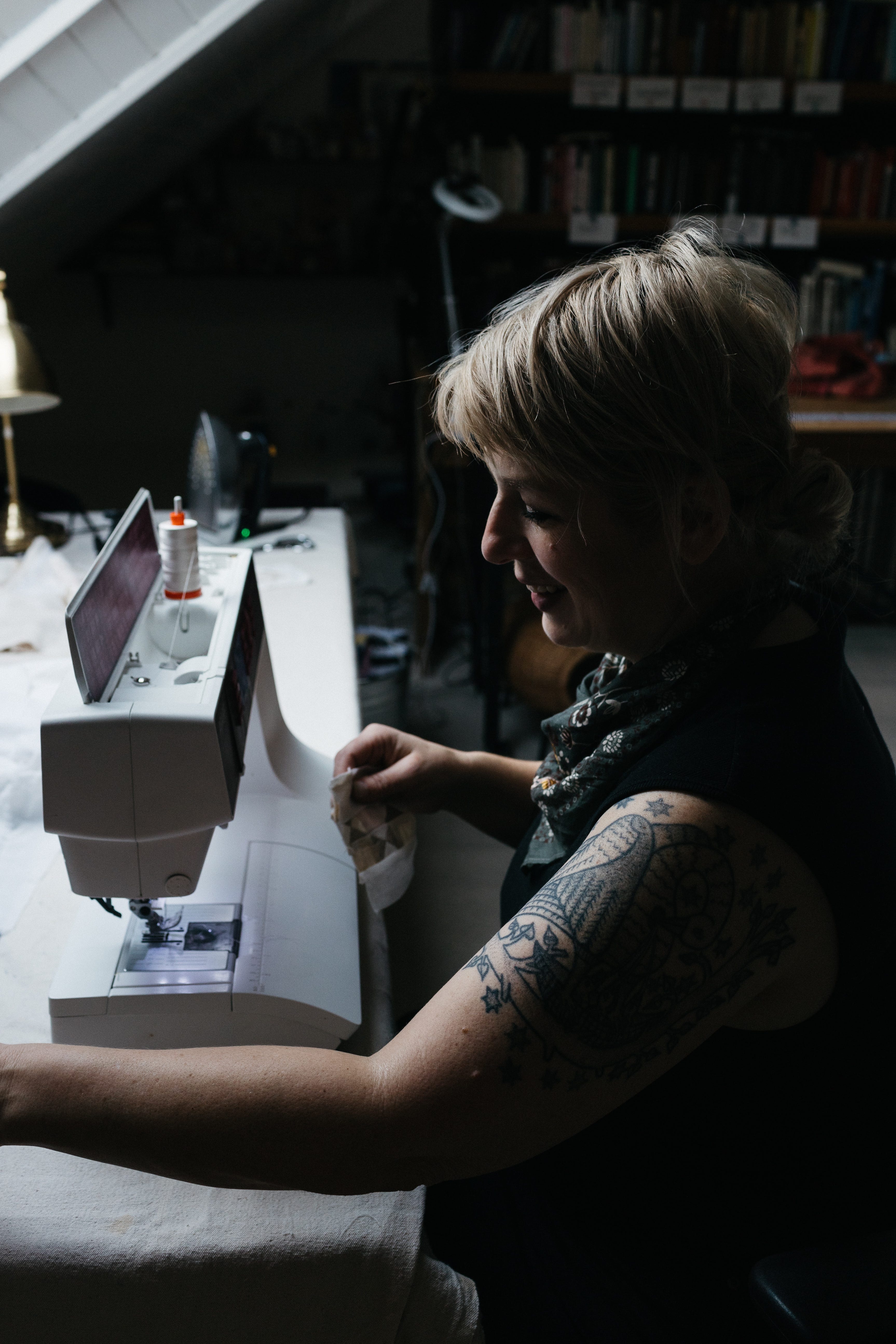
There is a third thing I do to prepare that is very practical. I will continue to make quilts. I have several designs I completed more than a year ago that are ready to make. So I’m going to keep working on what is in front of me. I’m not going to abandon my own practice just because something new feels like it’s coming. If anything, it’s the opposite: when life is about to shift, the insistence on my work is what helps me not disappear inside the shift. I’ll finish the designs I’ve already chosen, and I’ll trust that whatever is arriving will emerge from that steady contact with the material, not from my trying to force it into view.
What is coming next for me and my quilts? I see little incomprehensible glimpses. Instead of trying to pry open the future, I am naming what guides me and the cracks and explosions that have formed me. When it came to becoming a parent, no amount of nesting would have prepared me anyway. Having a child was a dramatic shift. It was total, irreversible. What saved me wasn’t the right furniture or the perfect plan. It was the insistence, even then, on keeping the thread of my own work intact: a practice that reminded me I was still here, still myself, even as new things emerged. That’s part of what I’m reaching for now.
Thinking through quilting is so helpful in these times when it feels like new things are emerging. These new things are nameless and faceless so what can we do? We can think. And keep quilting.
I appreciate your bravery and your long and wide perspective. Thanks for putting it out here for us.